Guest Opinion: Understanding Idaho’s Proposed High-Tech Hunting Rules
The following is a personal perspective written by Tal Sampson, a participant in IDFG’s Hunting and Advanced Technology (HAT) Working Group. Sampson was recently featured on The Ranch Podcast, where he discussed Idaho’s proposed high-tech hunting rules and the work of the HAT Committee. The episode is linked here for readers interested in hearing the full conversation.
Overview of the Idaho Fish and Game 2026 High-Tech Rules Proposal
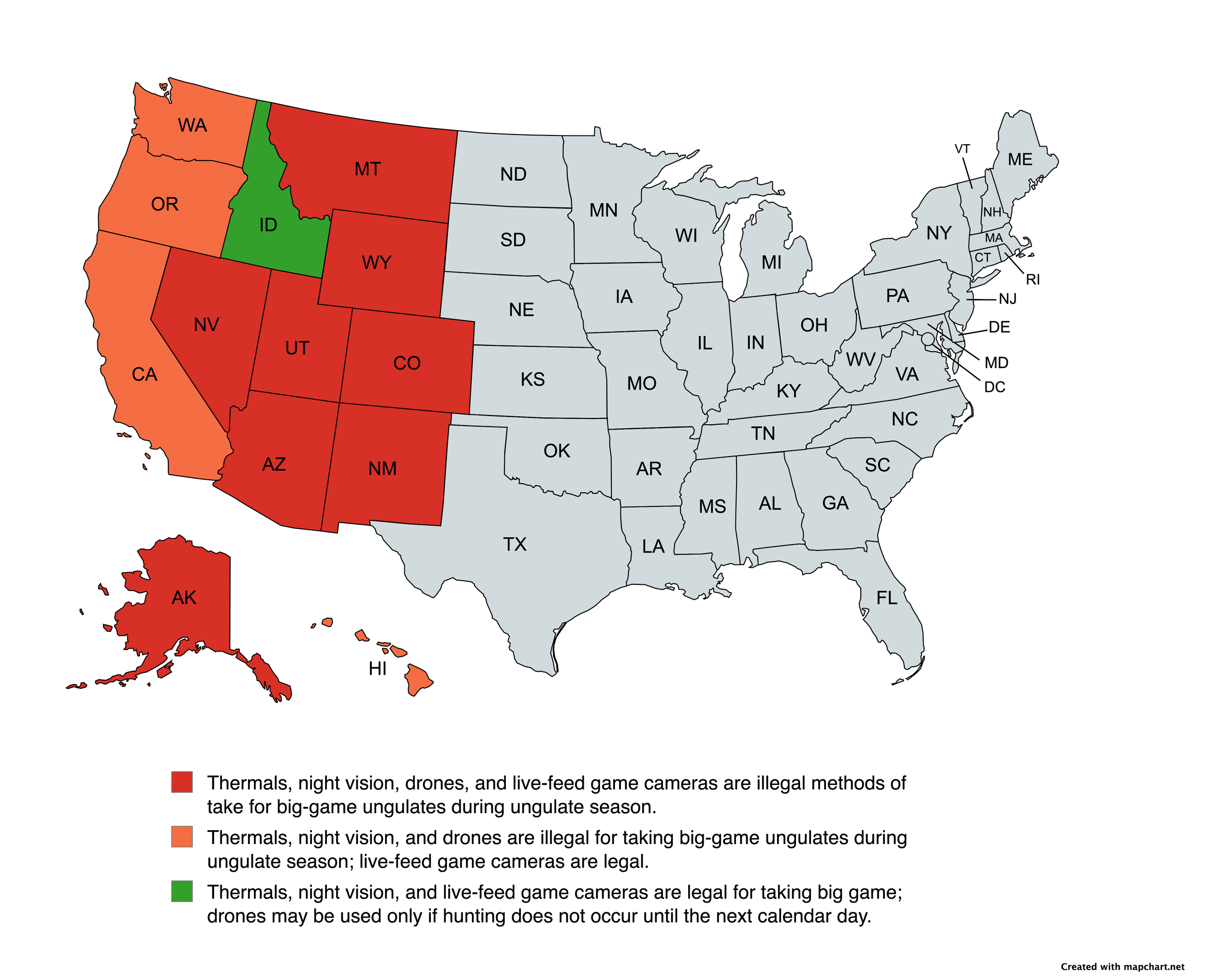
The Idaho Fish and Game (IDFG) 2026 High-Tech Rules Proposal is currently under review by the House Resources and Conservation Committee and the Senate Resources and Environment Committee. The proposal upholds fair-chase principles and sportsmanship by prohibiting the use of thermal imaging, night vision, drones, smart optics, and transmitting trail cameras while hunting big-game.
Idaho is currently the last state in the western third of the United States - including Alaska and Hawaii - to consider restrictions on these high-tech hunting devices. Nearly all other western states with large amounts of public land and abundant big-game populations have already enacted similar rules. Idaho ranks third in the nation for percentage of public land (66.5%) in the lower 48, making responsible wildlife management especially important.
Importantly, the IDFG 2026 High-Tech Rules Proposal applies only to the act of hunting big game animals: mule deer, elk, white-tailed deer, pronghorn, moose, mountain goat, bighorn sheep, black bear, mountain lion, grey wolf, and grizzly bear.
What the Proposal Does Not Affect
The proposed rules have zero impact on the use of these technologies for:
Monitoring private property or livestock
Agricultural operations
Wildlife photography or observation
Land management or security
These restrictions apply only to the act of hunting big game.
Key Dates and Restrictions
From August 30 through December 31, the proposal would prohibit the use of:
Thermal imaging
Night vision
Transmitting/live-feed trail cameras
Drones - Aircraft, including any unmanned aircraft system, for scouting or hunting. This restriction is in addition to the restrictions for use of aircraft in section 36-1101(b) Idaho Code. This restriction does not apply to aircraft flights with the purpose of picking up and discharging people or goods on direct routes between established airstrips or other pre-determined locations, without making detours for the purpose of scouting or hunting.
for scouting, hunting, or retrieval of big-game animals.
Wolves
Wolves are classified as big-game animals in Idaho; however, there’s a permit that allows expanded methods of take for wolf hunters.
Wolf hunters pursuing wolves only may obtain free-permits from an IDFG office.
The permits allow:
24-hour hunting permit and use thermals, night vision, smart optics, drones, and live-feed cameras.
Artificial light hunting permit and use thermals, night vision, smart optics, drones, and live-feed cameras.
These methods are legal from November 15 through March 31, once the permit is obtained, across almost the entirety of the wolf distribution in the state.
Wolf hunters can use thermals, night vision, drones, and live-game cameras from January 1 through August 29 during the wolf hunting season, even without the expanded methods of take.
Reporting Requirement: All hunters who harvest a wolf must present the skull and a portion of the hide (with evidence of sex) to an IDFG conservation officer or regional office within 10 days, including documentation of the method of take.
Harvest Data: From July-2021 to January 26, 2026 hunters have harvested 1,797 wolves in Idaho. Only 8 were taken using thermal imaging, and none occurred during the 77-day period between August 30 and November 15.
Black Bears
Black bears are also classified as big-game animals in Idaho.
Approximately 3,200 black bears are harvested annually.
About 45% are taken by bait hunters.
More than two-thirds of all bear harvest occurs during the spring season, regardless of method.
Important: All spring black-bear hunting - including spot-and-stalk and baited hunts - will be completely unaffected by the 2026 High-Tech Rules Proposal.
Mountain Lions
Mountain lions are big-game animals in Idaho, with approximately 600 lions harvested annually in recent years. The proposal does not meaningfully impact existing lion harvest opportunities. Mountain lion seasons are year-round in Idaho, and these technologies can be used outside the prohibition period January 1 through August 29.
Predators and Unprotected Species
Coyotes and other predatory or unprotected species—including raccoons, jackrabbits, skunks, weasels, rattlesnakes, marmots, fox squirrels, porcupines, opossums, and Columbian ground squirrels - may be taken in unlimited numbers and year-round, provided hunters hold the appropriate license and comply with local laws. Yes, thermals, night vision, smart optics, drones, and live-game cameras can be used for legal methods of take year-round.
The 2026 Proposed Rules do not affect predator or unprotected wildlife hunters in any way.
Why This Matters
Nearly the entire western United States - including Alaska, Hawaii, and British Columbia - has already restricted or prohibited high-tech devices during big-game seasons. If Idaho fails to pass these rules, it will become the only high-tech hunting state in the West, leaving its public wildlife resources vulnerable to unfair practices and increased pressure from non-residents using tools that other western jurisdictions have deemed inconsistent with fair-chase ethics.
Ungulates (hoofed mammals) are not predators and lack the biological mechanisms to adapt to or evade these technologies. High-tech devices overwhelmingly tip the balance and undermine ethical hunting standards. These tools, when applied correctly are appropriate for predator management - but not for big-game hunting seasons.
Protecting Idaho’s Hunting Heritage
Idaho has a proud history rooted in fair-chase ethics and strong outdoor traditions. Anti-hunting organizations are closely watching wildlife policy decisions, actively engaging in litigation related to wolf hunting in Idaho and Montana. With only about 6% of the U.S. population participating in hunting, it is critical that hunters demonstrate responsible stewardship.
A “wise-use” approach - is clearly essential. Available data shows that restricting high-tech devices for ungulates (hoofed mammals) will have little to no impact on predator harvest, while significantly protecting big-game populations and public trust.
Final Note on Agriculture and Ranching
Hunters and Idaho residents strongly support ranchers and agricultural producers. The proposed hunting technology restrictions would not limit their ability to use these technologies to:
Protect or monitor their livestock or domestic animals year-round.
Use live-feed cameras and drones during their operations year-round.
Monitor leased lands or property year-round.
Nothing in the pending rule language prohibits a producer from obtaining a kill authorization through their regional IDFG offices to use these technologies with depredation issues with wolves, black bears, mountain lions, or any other big-game.
Quote - under 36-1107(c) Idaho Code: “Livestock and domestic animal owners may take all steps they deem necessary to protect their property”.
Wolves can be hunted year-round on private land - but hunters must comply with trespass laws.
Trapping Wolves on private land during wolf trapping season only.
Ranchers provide essential habitat and support Idaho’s hunting culture. The proposed rule language applies only to the specific act of hunting big-game animals from August 30 through December 31 and does not interfere with agricultural operations in any way.